
Angkor Thom Temple
Contents
History of Angkor Thom Temple
Angkor Thom Temple — literally the “Great City” — was established in the late 12th century by King Jayavarman VII. Constructed as the capital of the Khmer Empire, Angkor Thom became the political, spiritual and cultural center of a vast Southeast Asian civilization. Over centuries the city evolved, blending Hindu and Buddhist iconography, though Jayavarman VII’s Mahayana Buddhist influence is most visible.
Layout & Architecture
Angkor Thom covers roughly 9 square kilometers and is surrounded by a wide moat and massive stone walls. The complex is arranged around the central Bayon Temple and features multiple terraces, causeways and palace compounds.
- Bayon Temple: Famous for dozens of smiling stone faces and extensive bas-reliefs.
- Terrace of the Elephants: A ceremonial platform used by the king.
- Terrace of the Leper King: A richly carved terrace with mythological scenes.
- Baphuon & Phimeanakas: Temple mountains and royal structures.
Top Highlights & What to See
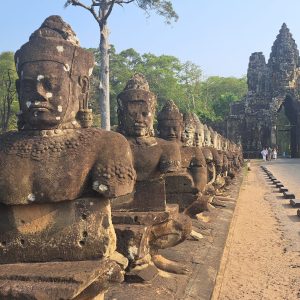
- South Gate: Photogenic entrance with rows of devas and asuras.
- Bayon faces: Iconic smiling faces — best at sunrise or late afternoon.
- Terrace of the Elephants: Great for wide shots and understanding royal pageantry.
- Victory Gate & Other Gates: Less crowded, perfect for quiet exploration.
- Hidden Corners: Northern and western sections are often quieter and full of discovery.
Best Time to Visit Angkor Thom Temple
For cooler temperatures and the best light, visit between November and February. Daily, aim for early morning (7–9 AM) or late afternoon (4–6 PM) to avoid the strongest sun and biggest crowds.
How to Get to Angkor Thom Temple
Angkor Thom sits inside the Angkor Archaeological Park about 10 km from Siem Reap town center. Common transport options include:
- Tuk-tuk — flexible and affordable for single travellers or couples.
- Bicycle — for active travellers; expect 30–60 minutes depending on starting point.
- Car/Van — comfortable for groups or when travelling with kids.
- Guided tour — ideal if you want historical context from a licensed guide.
Entrance Fees & Angkor Pass
Angkor Thom is within the Angkor Archaeological Park and requires an Angkor Pass. Typical rates are:
- 1-day pass — approx. $37 USD
- 3-day pass — approx. $62 USD
- 7-day pass — approx. $72 USD
Passes grant access to Angkor Thom, Angkor Wat, Ta Prohm and many other temples across the park. Keep your pass visible while inside the park.
Map & Coordinates
Practical Tips for Visiting
- Dress respectfully: cover shoulders and knees.
- Bring water, sun protection and comfortable shoes.
- Watch your step — ancient stones are uneven and can be slippery.
- Hire a licensed guide if you want in-depth history and stories.
- Respect signage and restricted areas; do not climb fragile reliefs.
Frequently Asked Questions
- Is Angkor Thom the same as Angkor Wat?
- No — Angkor Thom is the walled city containing Bayon and other temples; Angkor Wat is a separate, earlier temple complex.
- How long should I plan?
- Plan 2–3 hours for the main highlights; half a day if you want a relaxed exploration.
- Are there guides available?
- Yes — licensed local guides and audio guides are available at the park or via tour operators.