History of Angkor Thom Temple
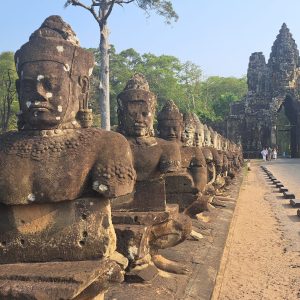
Angkor Thom Temple — literally the “Great City” — was established in the late 12th century by King Jayavarman VII. Constructed as the capital of the Khmer Empire, Angkor Thom became the political, spiritual and cultural center of a vast Southeast Asian civilization. Over centuries the city evolved, blending Hindu and Buddhist iconography, though Jayavarman VII’s Mahayana Buddhist influence is most visible.
Layout & Architecture
Angkor Thom covers roughly 9 square kilometers and is surrounded by a wide moat and massive stone walls. The complex is arranged around the central Bayon Temple and features multiple terraces, causeways and palace compounds.
- Bayon Temple: Famous for dozens of smiling stone faces and extensive bas-reliefs.
- Terrace of the Elephants: A ceremonial platform used by the king.
- Terrace of the Leper King: A richly carved terrace with mythological scenes.
- Baphuon & Phimeanakas: Temple mountains and royal structures.
Best Time to Visit Angkor Thom Temple
For cooler temperatures and the best light, visit between November and February. Daily, aim for early morning (7–9 AM) or late afternoon (4–6 PM) to avoid the strongest sun and biggest crowds.
Entrance Fees & Angkor Pass
Angkor Thom is within the Angkor Archaeological Park and requires an Angkor Pass. Typical rates are:
- 1-day pass — approx. $37 USD
- 3-day pass — approx. $62 USD
- 7-day pass — approx. $72 USD
Passes grant access to Angkor Thom, Angkor Wat, Ta Prohm and many other temples across the park. Keep your pass visible while inside the park.